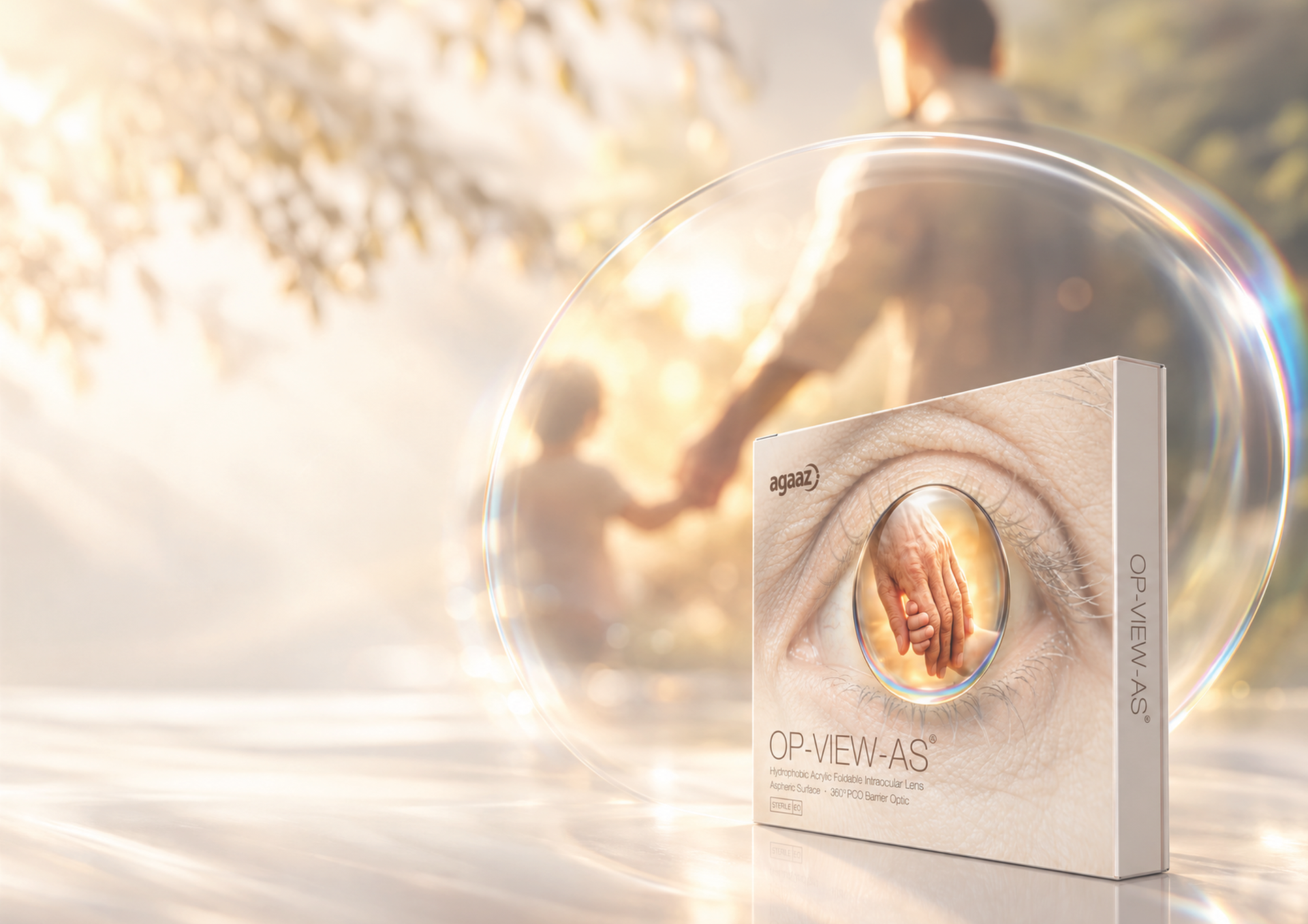
OP-VIEW AS
Hydrophobic acrylic aspheric foldable IOL with a 360° square-edge PCO barrier and glistening-resistant material, built for long-term clarity and stable fixation.
Engineering anatomy
Cut it anywhere. The edge stays square.
OP-VIEW AS is a single piece of high-index hydrophobic acrylic: a 6.0 mm aspheric optic with two modified-C haptics. Slide the light sheet across the optic and read the section on the screen. The profile thins toward the periphery and finishes in the same square edge all the way round, the 360° barrier the design relies on.
- Optic
- 6.00 mm aspheric
- Edge
- 360° square
- Material
- PEA/PEMA hydrophobic acrylic, BDDA cross-linked
- Refractive index
- 1.557
- Water content
- <1%
- Power range
- +5.00 to +30.00 D, 0.5 D steps
- Overall diameter
- 12.50 or 13.00 mm
- Light filtration
- UV (378 nm cut-off) + blue
- Sterilisation
- EO · 3-year shelf life
Three layers of
long-term protection.
OP‑VIEW AS combines structural, material, and optical protection into a single hydrophobic platform.
Built-In Protection
360° square-edge blocks epithelial cell migration. UV + blue filtration shields the retina. Ultra-low water content resists glistenings.
See OP‑VIEW AS up close.
Hydrophobic acrylic precision, engineered for clarity and protection.


Engineering anatomy
Preloaded, two ways.
The same optic also comes ready inside the injector: in the Agaaz standard preloaded system, or in the Medicel system imported from Switzerland. Neither needs the lens handled. Choose a system and step through its method of use, from viscoelastic to the click-lock.
- Standard incisions
- 2.6 · 2.8 · 3.0 mm
- Medicel incisions
- 2.4 · 2.6 · 2.8 mm
- Standard tip · dock-in
- 2.10 · 2.40 mm
- Tip angulation
- 60° (standard)
- Medicel
- Switzerland · optional haptic pre-folding
- Also supplied
- Butterfly cartridge + injector
Incisions are wound assisted · into the wound · into the bag. Standard method of use: 1, push the plunger forward until the lateral notch is flush with the housing end and it clicks; 2, apply viscoelastic from the distal end to the complete tip, and to the top and bottom of the lens; 3, press the wings together to the click-lock; 4, press the plunger forward until the blue silicone tip reaches the end of the housing. Medicel: viscoelastic into the cartridge and along the lens path, optional haptic pre-folding, then the click-lock wings close and it is ready for delivery.
Technical profile.
Formulated for hydrophobic behaviour, balancing machining precision, refractive index, and foldability.
Material
Optic Design
Refractive index
Edge Design
Diopter range
Filtration
Material behaviour
Tg 11.4°C and an elastic modulus of 2.9 MPa support a soft, foldable material, engineered for small-incision delivery and controlled, rapid unfolding. OP‑VIEW AS folds more readily than most hydrophobic acrylics on the market.1
View full material specifications
1 Based on Agaaz internal material characterization data.
Why surgeons trust
hydrophobic aspheric.
OP‑VIEW AS targets three long-term priorities in cataract surgery: PCO reduction, optical integrity, and retinal safety.
PCO Prevention Architecture
The 360° square-edge creates a sharp discontinuity at the optic-capsule interface, mechanically blocking the lens epithelial cell migration that drives posterior capsule opacification.
Square EdgeRetinal Light Protection
UV and blue light filtering chromophores embedded in the material protect the retina the way the natural crystalline lens does, reducing phototoxic exposure to the macula.
UV + Blue FilterGlistening resistance
Ultra-low <1% water content supports truly hydrophobic material behaviour, designed to resist microvacuole formation (glistenings) that can degrade optical quality over time.
Long-Term ClarityAspheric Contrast Enhancement
The aspheric profile improves contrast sensitivity across lighting conditions, so patients keep functional vision quality in everyday activities.
Optical QualityWhat the published literature says about hydrophobic acrylic aspheric iols
The clinical case for this product category does not rest on our own material. The studies below are independent, peer-reviewed and indexed in PubMed, and they cover hydrophobic acrylic aspheric iols as a subject. Each entry links to its PubMed record so the primary source can be read in full.
- Randomized Controlled TrialGlistenings, anterior/posterior capsular opacification and incidence of Nd:YAG laser treatments with two aspheric hydrophobic acrylic intraocular lenses - a long-term intra-individual studyJohansson B (2017) · Acta ophthalmologica · PMID 28371401
- Randomized Controlled TrialGlistenings 9 years after phacoemulsification in hydrophobic and hydrophilic acrylic intraocular lensesChang A & Kugelberg M (2015) · Journal of cataract and refractive surgery · PMID 26100954
- Randomized Controlled TrialIntraindividual comparative analysis of capsule opacification after implantation of 2 single-piece hydrophobic acrylic intraocular lenses models: Three-year follow-upKahraman G et al. (2015) · Journal of cataract and refractive surgery · PMID 25953472
Independent peer-reviewed publications indexed in PubMed. Listed as clinical background on the molecule and device class; they are not studies of Agaaz products and imply no endorsement.
Interested in OP‑VIEW AS?
Contact Agaaz Ophthalmics for pricing, regulatory documentation, diopter availability, or distribution partnership enquiries.
