OP‑CHOLCarbachol Intraocular Solution 0.01%
OP‑CHOL is a 0.01% carbachol intraocular solution that constricts the pupil within 2–3 minutes at the close of cataract surgery, supporting stable wound closure, IOL centering, and post-operative IOP management.
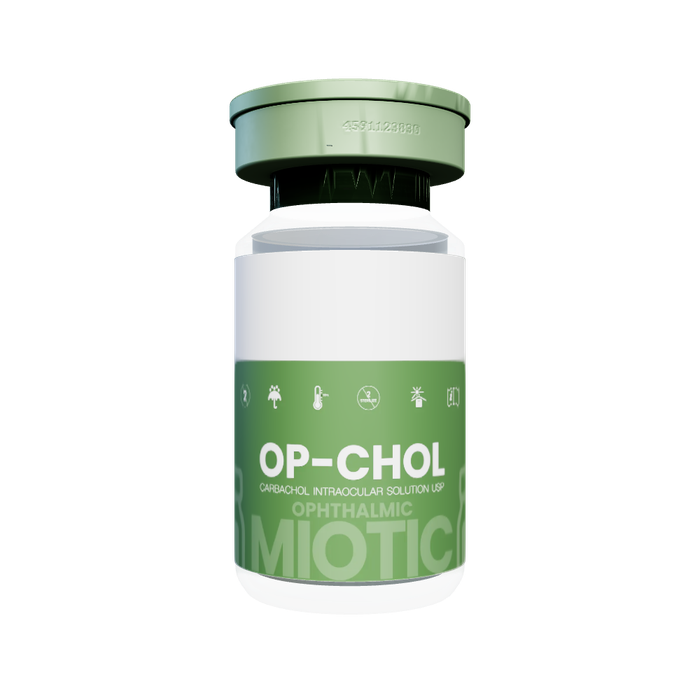
See OP‑CHOL up close.
Professional packaging with clear product identity, designed for confident selection in the operating theatre.


A controlled finish
to every cataract case.
OP‑CHOL is built for the critical last step: rapid, predictable pupillary constriction that supports wound stability, IOL positioning, and post-operative IOP control.
Rapid Pupil Control
Achieves prompt miosis within 2–3 minutes of intracameral injection, giving the surgeon immediate pupillary constriction when needed.
IOP Reduction
Reduces the intensity of intraocular pressure elevation in the first 24 hours after cataract surgery, a clinically meaningful post-operative benefit.
Sustained Duration
Unlike acetylcholine which lasts minutes, carbachol provides miosis lasting up to 24 hours, reducing the need for supplementary miotics post-operatively.
Wound Stability
A constricted pupil at the close of surgery helps prevent iris prolapse, supports self-sealing wound architecture, and assists IOL centration.
How OP‑CHOL achieves
pupillary constriction.
Carbachol is a parasympathomimetic that directly activates acetylcholine receptors in the iris sphincter muscle, producing rapid and sustained miosis.
Intracameral Injection
OP‑CHOL is injected gently into the anterior chamber parallel to the iris face and tangential to the pupil border at the conclusion of cataract surgery.
Dual Receptor Activation
Carbachol directly stimulates both muscarinic and nicotinic acetylcholine receptors on the iris sphincter muscle, a dual mechanism providing more sustained effect than acetylcholine alone.
Iris Sphincter Contraction
Receptor activation triggers contraction of the circular iris sphincter muscle fibres, producing concentric pupillary constriction (miosis) within 2–3 minutes.
Sustained Miosis + IOP Control
The miotic effect is maintained for up to 24 hours. Simultaneously, increased aqueous humour outflow helps reduce post-operative IOP elevation, a dual clinical benefit.
Key parameters at a glance.
What the published literature says about intracameral carbachol and postoperative iop
The clinical case for this product category does not rest on our own material. The studies below are independent, peer-reviewed and indexed in PubMed, and they cover intracameral carbachol and postoperative iop as a subject. Each entry links to its PubMed record so the primary source can be read in full.
- Randomized Controlled TrialEffect of intracameral carbachol on intraocular pressure following clear corneal phacoemulsificationCekiç O & Batman C (1999) · Eye (London, England) · PMID 10450383
- Randomized Controlled TrialEffects of intracameral carbachol and acetylcholine on early postoperative intraocular pressure after cataract extractionKim JY et al. (1994) · Korean journal of ophthalmology : KJO · PMID 7853733
- Randomized Controlled TrialNatural course of intraocular pressure after cataract extraction and the effect of intracameral carbacholGupta A et al. (1992) · Journal of cataract and refractive surgery · PMID 1564656
Independent peer-reviewed publications indexed in PubMed. Listed as clinical background on the molecule and device class; they are not studies of Agaaz products and imply no endorsement.
Common questions about
carbachol and OP‑CHOL.
Add OP‑CHOL to your cataract range.
Share your market and expected quantities. We’ll respond with commercial details and the documentation pack aligned to your route.
